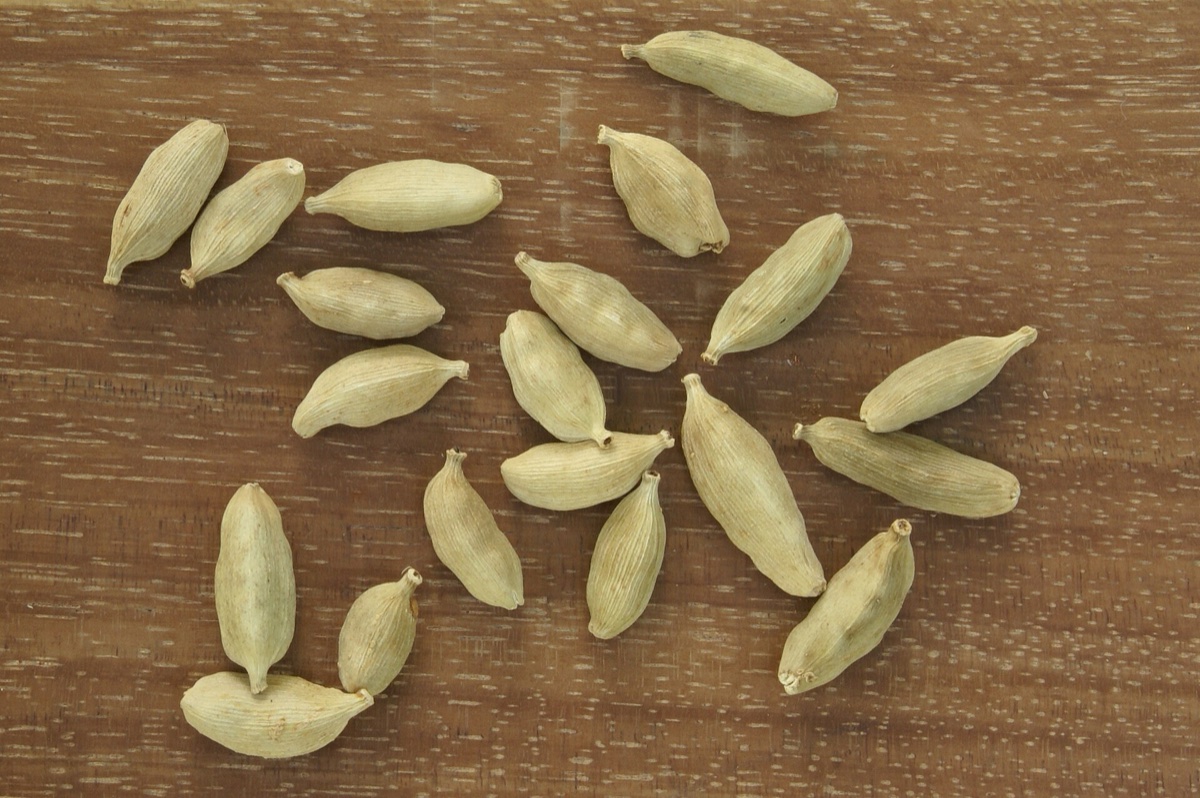
India's cardamom export earnings jumped from $201 million in FY2024-25 to $437 million in FY2025-26, with shipped volumes more than doubling in a single year (Export Import Academy). Small cardamom now brings in 9% of India's entire $4.43 billion spice export basket (Spices Board). The trigger sits 15,000 km away: Guatemala, the world's dominant supplier, harvested roughly 17,000 tonnes this season against a normal 40,000–50,000 (IREF). Gulf buyers who spent a decade on Guatemalan pods are suddenly calling Kerala.
Which buyers, exactly? That's the part most growers around Idukki never see. The cardamom export data behind the headline names the importing firms in Riyadh, Dubai and Kuwait City — shipment by shipment, with volumes and dates. This post reads that data: who buys, at what price, under which HS code, and how to turn the records into orders.
The 30-second version
- India's cardamom exports roughly doubled to $437 million in FY2025-26, up from $201 million a year earlier (Export Import Academy).
- Saudi Arabia is the world's #1 cardamom importer: $251.5 million in 2024, ahead of the UAE at $222 million (World's Top Exports).
- Guatemala's crop collapsed to about 17,000 tonnes vs a normal 40,000–50,000 — India could ship 12,000–14,000 tonnes this season, double its usual 6,000–8,000 (IREF).
- Idukki district in Kerala grows about 70% of India's cardamom (The South First); auction averages ran ₹2,726/kg in July 2026 (Cardamom.Auction).
- Whole cardamom ships under HS 090831; crushed or ground under HS 090832.
What does the latest cardamom export data show?
A supply flip. For years India grew a lot of cardamom and exported little of it — domestic demand absorbed 24,463 tonnes of production (2022-23) while exports idled at 5,000–6,000 tonnes a year (The South First). FY2025-26 broke the pattern. With Guatemalan supply short, Indian exporters project 12,000–14,000 tonnes for the season — double the norm — on auction arrivals of 30,000–31,000 tonnes for calendar 2025 (IREF).
The doubling in dollars looks even sharper against the recent past. In calendar 2024 India's cardamom export trade was worth $206.8 million, a 21.8% world share (World's Top Exports). One drought year earlier, Idukki had written off ₹113 crore of crop across 16,621 hectares, hitting 22,311 growers (The South First). From that low to a $437 million export year in 24 months — the exporters who track the data moved first.
Which country imports the most cardamom?
Saudi Arabia imports the most cardamom — $251.5 million in 2024, 25.3% of world imports — followed by the UAE at $222 million (22.3%), per Comtrade-based figures from World's Top Exports. The top five buyers by value:
- Saudi Arabia: $251.5 million (25.3%)
- United Arab Emirates: $222 million (22.3%)
- India: $83 million (8.3%)
- China: $52.1 million (5.2%)
- Bangladesh: $47.9 million (4.8%)
Two oddities in that list are worth decoding. India appears as a big importer because domestic demand outruns its own crop in bad years — it buys Guatemalan pods to blend and re-sell. And the UAE's number overstates what Emiratis consume: Dubai is a re-export hub that pushes cardamom onward across the Gulf, East Africa and Iran. In Europe the pattern splits by origin — Germany sources 86% of its cardamom from Guatemala, while 30% of UK imports come from India (CBI).
Cardamom HS code: 090831 and 090832
Whole pods — neither crushed nor ground — travel under HS 090831; crushed or ground cardamom under HS 090832 (World's Top Exports). Older statistics often aggregate both under the legacy six-digit head 090830, so a 2019 series and a 2024 series may not match line for line. Whole pods dominate the trade: about 74% of European imports arrive whole, because grinding early kills the volatile oil that buyers pay for (CBI).
Note what the six-digit code hides: 090831 covers both small green cardamom (Kerala's crop) and large black cardamom (grown in the Northeast and Nepal — which exported $63 million of it in 2024). When you pull shipment records, filter by product description as well as code, or Nepal's black pods pollute your green-cardamom analysis. New to code-based searching? Start with what an HS code is and how to use it.
India vs Guatemala: who supplies the world?
Guatemala, still — but the gap is closing fast. In 2024 Guatemala shipped 28,321 tonnes worth $496.6 million, over half the world's cardamom by value; India held 21.8% (Guatemala Portal, World's Top Exports). The two origins barely compete on price. Guatemalan cardamom fetched $5.06–6.17 per kg in 2025; Indian 8 mm bold pods quote around $35 per kg (IREF). Guatemala sells volume for gahwa blends and grinding; Kerala sells colour, oil and pod size to premium buyers.
Guatemala's drought didn't just cut supply — it sent Saudi and Kuwaiti importers who normally never look at Indian prices straight to the Puttady auction board.
That segmentation is exactly why the current shortage matters. With Guatemala at ~17,000 tonnes and next season projected near 22,000 because drought-hit estates weren't replanted (IREF), mid-market Gulf buyers are trading up to Indian pods not out of preference but necessity. Such windows closed fast in past cycles; exporters who lock in relationships now keep the business after Guatemala replants.
Cardamom export price from India in 2026
Start at the auction. On 9 July 2026, 32,590 kg arrived at the Spices Board e-auction and averaged ₹2,726 per kg, with the best lots touching ₹3,718 (Cardamom.Auction) — up from a calendar-2025 average of about ₹2,520 (IREF). Export quotes build from there: bulk FOB India runs $12–20 per kg depending on grade, and 8 mm bold green — the Alleppey Green extra-bold end of the spectrum — commands around $35 per kg (Export Import Academy, IREF).
Small cardamom exporters in Kerala live between those two numbers. The working rhythm around Puttady and Vandanmedu: watch the daily auction, buy on dips, grade by pod size and colour, and time containers so they land in Jeddah and Dubai six to eight weeks before Ramadan — Arabic coffee roasters restock hardest then, and Eid gifting follows (IREF). Miss the window and the same pods sell for less. One price spike mid-contract can erase a shipment's margin — which is why nobody serious quotes flat for a quarter.
Where Kerala's cardamom goes: Saudi, UAE, Kuwait lanes
Idukki district grows about 70% of India's cardamom (The South First), and the Gulf takes most of what leaves the country. Saudi Arabia, Kuwait, the UAE, Iran and Qatar anchor the buyer list, with the US, UK, Canada and Japan behind them (Export Import Academy). Since Guatemala's crop failed, fresh inquiries from Saudi Arabia, the UAE and Kuwait have been landing with Indian shippers directly (IREF).
A Saudi roaster who switched origins this season is a relationship an Idukki exporter can keep for a decade — if they find the right firm before a competitor does.
Each lane has its own spec. Saudi gahwa roasters want bold, uniformly green pods and will pay the 8 mm premium. Dubai traders buy wider grade ranges to re-export. European buyers — the UK alone imported 785 tonnes in 2023 (CBI) — add pesticide-residue documentation on top. Same spice, three different sales pitches.
How ShipScout turns cardamom export data into buyers
ShipScout is a global trade-intelligence platform — 11 billion-plus shipment records across 240+ countries, built as an affordable alternative to Panjiva and ImportGenius. It helps Indian spice exporters find and vet buyers with data-backed targeting, working from mirrored licensed trade data for India-linked trade. The cardamom workflow:
- Search HS 090831 and 090832. See which importers in Saudi Arabia, the Gulf and Europe are receiving cardamom right now, and how often. Start in the company directory.
- Rank buyers by volume per market. A UAE importer clearing pods monthly beats ten one-off buyers — sort by shipment cadence and work the top of the list.
- Vet before extending credit. A buyer's real shipment history tells you more than their website — here's how to verify an international partner before paying.
- Reach the decision-maker. Contact intelligence (where available) gets you past the info@ inbox; the wider playbook is in finding buyers for export from India.
One habit that converts: pull a target importer's recent cardamom receipts and open your first email with the specifics — origin, grade, monthly tonnage, the price trend on their current supplier. Buyers reply differently when you clearly know their purchasing. The same play just delivered a record year for cumin exporters. Guatemala's shortfall wrote the opportunity; the buyer list already exists — Start a free trial and search HS 090831 to read it.
See who’s importing cardamom buyers right now.
ShipScout turns 11B+ shipment records across 240+ countries into a live list of verified buyers and suppliers — ranked by volume, with the contacts to reach them. Create a free account and run your first search in minutes.
Start your free trial →