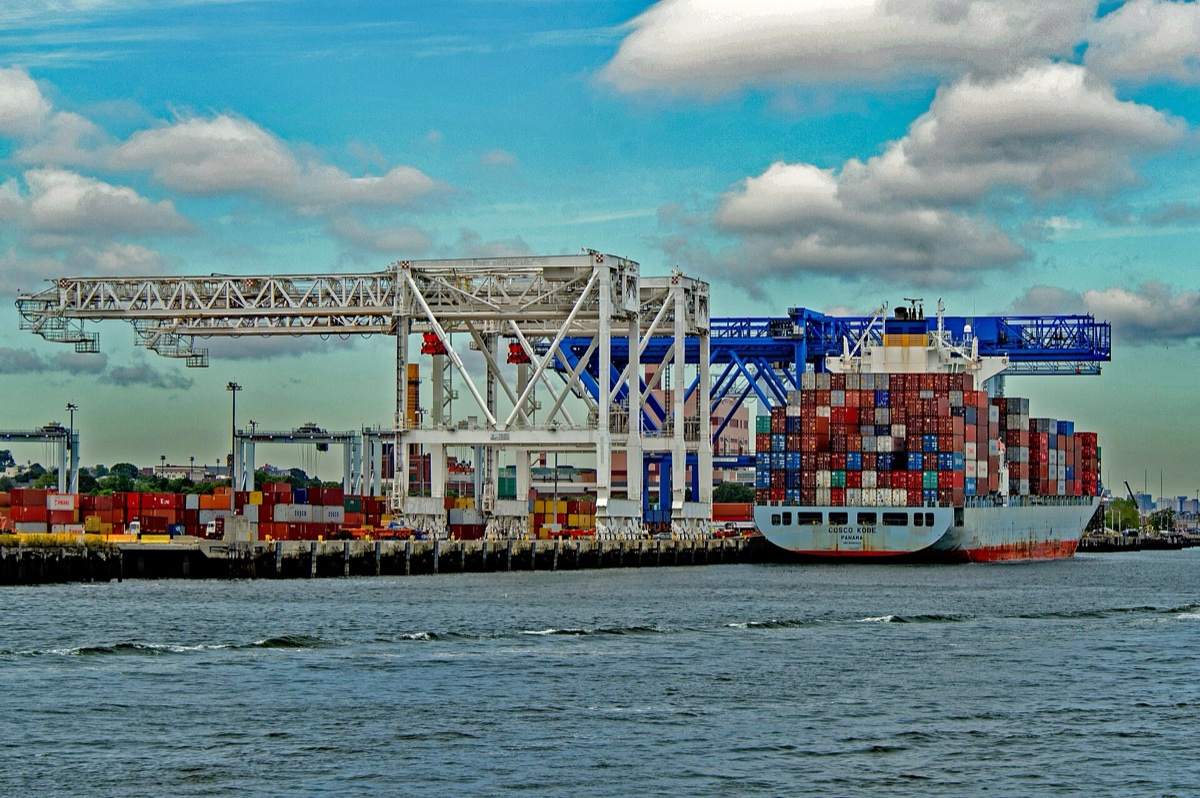
Ocean freight is what turns the CIF vs FOB choice into real money. Drewry's World Container Index hit $4,639 per 40ft container on 9 July 2026 — its highest level since September 2024 and roughly 61% above the same week last year, per Drewry and IndexBox's WCI coverage. Shanghai to Rotterdam now runs $4,933; Shanghai to New York, $7,902. Whether that bill sits inside your price or lands on your buyer depends on three letters in the quote.
This guide works through the CIF vs FOB difference the way exporters meet it: who books the vessel, who pays what, where risk really transfers (the part almost everyone gets wrong), a worked example at July 2026 rates, and when to quote each. Both terms come from Incoterms 2020 — CIF meaning Cost, Insurance and Freight; FOB, Free on Board. Both are sea-freight terms only.
The 30-second version
- Risk transfers at the same point under both terms: when goods are loaded on board at the origin port. CIF does not mean the seller carries risk to destination.
- FOB: buyer books and pays ocean freight and insurance. CIF: seller pays freight plus mandatory minimum insurance — Institute Cargo Clauses (C) at 110% of invoice value.
- At July 2026 rates, freight is about 9% of a $55,000 CIF quote — and the index moved 61% in a year, so CIF quotes go stale fast.
- Customs angle: India assesses import duty on CIF value, the US on FOB; India's RoDTEP rebate pays 0.3–4.3% of FOB value.
- Shipping containers? The ICC says use FCA or CIP instead — FOB and CIF were built for bulk and break-bulk cargo.
What is the difference between CIF and FOB?
Under FOB the buyer books and pays for ocean freight and insurance; under CIF the seller pays freight and minimum insurance to the destination port. Risk transfers identically under both — the moment goods are loaded on board the vessel. Only costs and booking control differ.
Three practical consequences follow, per the Trade Finance Global CIF guide and Shipping Solutions' comparison:
- Control: FOB puts carrier choice, routing and freight negotiation in the buyer's hands; CIF keeps them with the seller.
- Cash: a CIF price is bigger because it swallows freight and insurance — the seller fronts those costs and recovers them in the invoice.
- Claims: under CIF the seller buys the policy but the buyer claims on it, because loss at sea is the buyer's risk.
CIF vs FOB: who pays for what
| Cost or task | FOB — seller pays | CIF — seller pays |
|---|---|---|
| Export packing and inland haul to origin port | ✓ | ✓ |
| Export customs clearance | ✓ | ✓ |
| Loading on board the vessel | ✓ | ✓ |
| Ocean freight to destination port | — | ✓ |
| Marine insurance (ICC-C, 110% of invoice) | — | ✓ |
| Import clearance, duties, delivery inland | — | — |
| Risk once goods are on board | — | — |
Read the last row twice. It is the whole exam question: under both terms, everything that happens after loading — storm damage, general average, a grounded vessel — is the buyer's problem. The seller's extra CIF obligations are cost obligations, not risk obligations.
Where does risk transfer? The part everyone gets wrong
Delivery under CIF happens when the seller loads the goods on board at the origin port — not when the vessel arrives, as Trade Finance Global's rule summary spells out. FOB is the same. So a buyer who thinks "CIF means the seller is responsible until Rotterdam" is wrong in the way that costs money: the seller is responsible for paying the freight to Rotterdam, while the buyer has carried the risk since the container crossed the ship's rail in Asia.
Under CIF, the seller buys insurance for a voyage that is already the buyer's risk.
That insurance is deliberately thin. CIF requires only Institute Cargo Clauses (C) — named perils such as fire, sinking, collision and jettison — and, per the rule text, cover of "at least 110 per cent of the invoice value" in the invoice currency. ICC-C excludes theft, water damage and rough handling, which the ICC Academy contrasts with CIP's all-risks ICC-A default under Incoterms 2020. Buyers of manufactured goods on CIF terms routinely top up to ICC-A at their own cost — or insist the contract upgrades the seller's obligation.
CIF vs FOB worked example: one 40ft container
Take a $50,000 order packed into one 40ft container on an Asia–North Europe lane, priced off Drewry's $4,933 Shanghai–Rotterdam benchmark (9 July 2026). Marine cargo cover for general cargo runs about 0.3–0.5% of insured value, per CargoInsurePro's 2026 cost guide. Insuring 110% of the CIF value at 0.3% comes to roughly $182.
- FOB quote: $50,000. Buyer books the vessel, pays the $4,933 freight and arranges its own insurance.
- CIF quote: about $55,115 — goods $50,000 + freight $4,933 + insurance $182. Same goods, same on-board risk transfer.
Freight is about 9% of that CIF price — and it is the volatile 9%. A year earlier the composite index sat near $2,800 (it has since risen 61%, per IndexBox). An exporter who issued 90-day CIF validity in spring and shipped into July's peak-season rates ate most of that increase; carriers stacked surcharges on top, including one line's $3,000 peak-season surcharge from 15 July. Experienced CIF sellers now quote freight "subject to revision at shipment" or cap validity at 15–30 days. FOB sellers never have this conversation.
When should you quote CIF, and when FOB?
Most FOB vs CIF shipping decisions come down to who buys freight better — and to two regulatory quirks.
Quote FOB when the buyer is a regular importer with its own freight contracts (large buyers usually demand it), when you cannot hold freight risk through a volatile quarter, or when the buyer's customs regime rewards it. US customs values imports on an FOB basis — duty is calculated before international freight — while India, the EU, China and most others assess duty on CIF, per DutyGlobal's valuation guide. Indian customs even adds notional insurance of 1.125% of FOB when the actual premium isn't documented, per EximPe's assessable-value guide. Every dollar of freight inside a CIF invoice becomes dutiable in those markets.
Quote CIF when the buyer is small or new to importing and wants one number covering goods-plus-voyage, when your forwarder's rates beat what the buyer can get, or when a small margin on freight is available. Exporters shipping under letters of credit also care that the on-board bill of lading a CIF or FOB sea shipment produces is exactly what banks want to see — our bill of lading guide and LC guide cover that chain.
One India-specific note: export incentives key off FOB value regardless of what you quote. RoDTEP rebates run 0.3–4.3% of FOB value depending on HS code, per ClearTax — on a CIF invoice, the freight and insurance legs earn nothing. With India's merchandise exports at $441.74 billion in FY2025-26, per Ministry of Commerce figures, that FOB-based math shapes how a very large pool of quotes gets written.
Shipping containers? The ICC says use FCA or CIP instead
FOB and CIF transfer risk "on board" — sensible for bulk cargo poured into a hold, awkward for a container you handed to the carrier at a yard days before loading. During that gap the box sits in the terminal at the seller's risk under FOB/CIF, even though the seller has zero control over it. The ICC's fix, restated in the ICC Academy's FCA-or-FOB guidance, is FCA for containerised cargo — risk passes at handover to the carrier — and Incoterms 2020 lets an FCA seller obtain an on-board bill of lading for LC purposes.
"CIP is the appropriate rule when goods are transported in containers or on pallets, and when multiple modes of transportation will be used." — ICC Academy, Incoterms 2020
In practice, habit wins: most container shipments still move on FOB and CIF quotes. Knowing the gap exists is the point — either switch terms, or make sure insurance actually covers the yard-to-ship window.
How ShipScout helps you win the terms argument
Incoterms are negotiated, and the side with better information negotiates from strength. ShipScout puts 11B+ shipment records across 240+ countries behind that negotiation:
- Profile the buyer before you concede terms. A prospect's shipment history in the company directory shows real volumes, lanes and suppliers — a monthly importer with fixed freight contracts will demand FOB; an occasional buyer is a natural CIF customer.
- Read the lane. US bill-of-lading data is public record, so you can see which carriers and ports your competitors' shipments use — groundwork our customs-data playbook walks through.
- Build the pipeline first. Terms only matter once there's an order; the outreach sequence in our find-buyers guide pairs ranked buyer lists with contact intelligence where available.
Quote CIF or FOB with the buyer's real shipping behaviour in front of you — Start a free trial and pull a prospect's shipment history before your next offer.
See who’s importing your product right now.
ShipScout turns 11B+ shipment records across 240+ countries into a live list of verified buyers and suppliers — ranked by volume, with the contacts to reach them. Create a free account and run your first search in minutes.
Start your free trial →