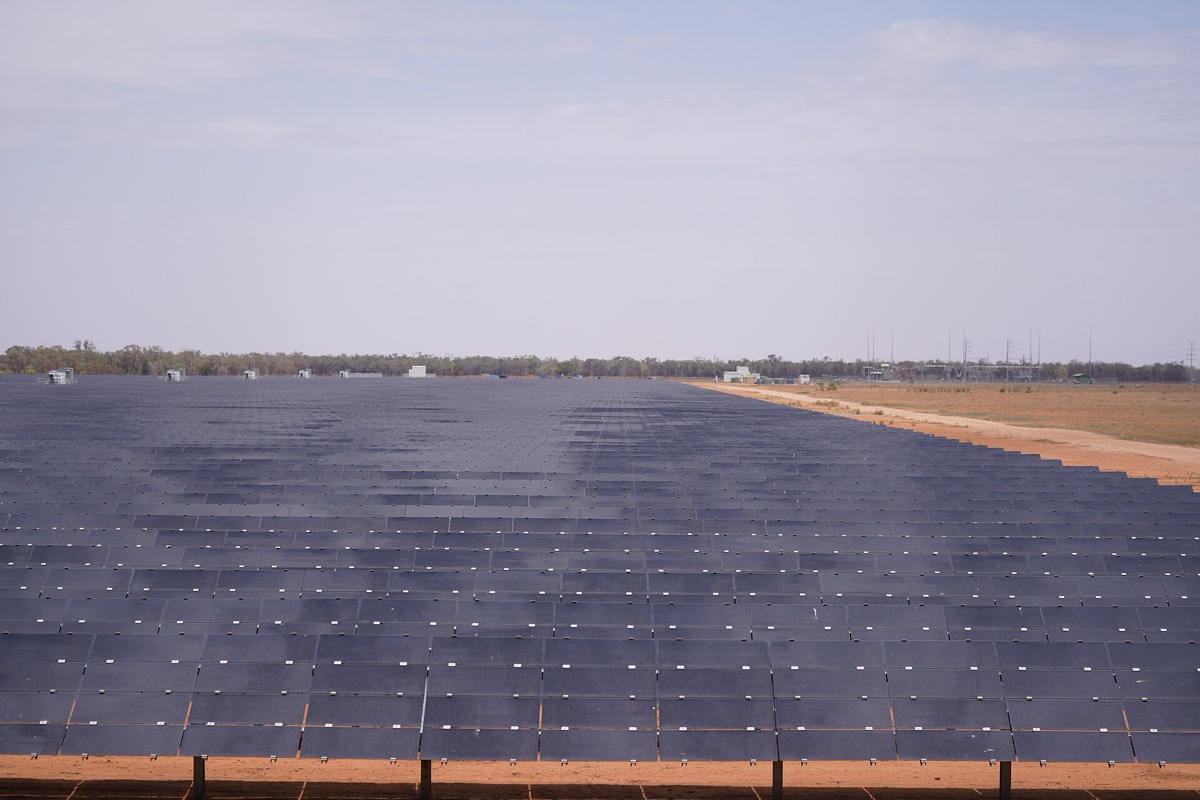
China shipped $22.05 billion of solar panels, cells and wafers in the first nine months of 2025. That was a down year: export value fell 14.9% as module prices bottomed out, even while shipment volumes rose. A single six-digit customs code sits behind almost all of it — HS 854143, photovoltaic cells assembled into modules — and it's where every useful piece of solar panel import data begins.
The map keeps moving. In February 2026 the US slapped a preliminary 126% duty on solar cells and panels from India, with 143% on Indonesia and 81% on Laos. Indian solar stocks fell double digits the same week. A year earlier it was Cambodia, Malaysia, Thailand and Vietnam in the crosshairs. Tariffs keep chasing Chinese-linked module supply from country to country, and the only way to see where volume lands next is the shipment record. Here is the 2026 PV module trade map, and how to read it.
The 30-second version
- China exported $22.05 billion of PV products in 9M 2025 and 236 GW of modules in 2024 — it controls over 80% of every solar manufacturing stage.
- The key customs codes: HS 854143 (cells assembled into modules/panels) and 854142 (cells not yet assembled).
- The US imported $12.9 billion of solar gear from Cambodia, Malaysia, Thailand and Vietnam — ~77% of module imports — before hitting them with AD/CVD duties up to 3,521%.
- In February 2026 Washington added a preliminary 126% duty on Indian modules, 143% on Indonesia, 81% on Laos.
- India's module capacity topped 210 GW by end-2025, but it exported only ~5 GW — with 96.8% headed to the US.
Which country exports the most solar panels?
China, by an enormous margin. It exported $22.05 billion of PV products in 9M 2025 and 235.9 GW of modules in 2024, and the IEA puts its share of every manufacturing stage above 80%, rising toward 95% for wafers.
Nobody else ships a tenth of that. Demand keeps pulling, too. BloombergNEF expects the world to install around 698 GW DC of solar in 2025, up 17% on 2024, climbing to 753 GW in 2026. Every one of those gigawatts is a module somebody imported. One detail in the Chinese figures matters more than the headline: 9M 2025 cell exports jumped 90%. Cells are what other countries assemble into finished panels, so the surge tells you assembly is migrating while upstream manufacturing stays put. For how this fits the wider hardware shift, see our electronics components trade data guide.
China ships roughly four of every five solar modules that cross a border. The trade story of 2026 isn't whether that changes — it's which countries the tariff walls push the volume through next.
Solar panel export data: where the buyers are
Follow China's 236 GW of 2024 exports and you get a heat map of global demand. Europe took the largest single slice at 94.4 GW, though that was down 7%. Asia-Pacific followed at 68.1 GW (up 26%) and the Americas at 33.3 GW. The growth sits further out: the Middle East nearly doubled to 28.8 GW (up 99%) and Africa jumped 43% to 11.4 GW. Those two regions are where new solar module importers are appearing fastest.
The lesson for exporters: don't chase only the saturated European market. The volume growth, and the least crowded buyer field, is in the Gulf, Africa and Southeast Asia, where import demand is compounding off a low base. Shipment records let you rank importers in each of those markets by how much they actually buy, not by who has the flashiest website.
How tariffs rewrite US solar panel import data
The United States is the world's most distorted solar market, and the clearest case study in reading trade data around tariffs. In 2024 the US imported roughly $12.9 billion of solar equipment from Cambodia, Malaysia, Thailand and Vietnam — about 77% of its module imports. Then Commerce dropped the hammer. The cases centred on Southeast Asia transshipment — Chinese-linked factories finishing modules offshore to sidestep China-specific duties — and the final anti-dumping and countervailing (AD/CVD) rates landed in 2025 at up to 3,521% for Cambodia, 972% for Thailand, 814% for Vietnam and 250% for Malaysia.
Supply simply relocated. By 2025 the top US module sources were Indonesia, Laos and India, yet total US panel imports still ran to around 33 GW, as Cambodia collapsed from 4.5 GW to 3.3 MW. So Washington moved the goalposts again with February 2026's duties on India, Indonesia and Laos. This whack-a-mole is exactly why importers track solar panel import data continuously: the cheapest compliant source changes every few quarters, and US bill-of-lading records are public. The pivot shows up in the records early, too: consignee names stay put while shipper addresses hop borders. Our US import data guide walks through tracking these shifts.
Tariffs don't kill import demand — they relocate it. Every duty ruling is a starting gun for a new sourcing country, and the shipment record shows you the winner months before the trade press does.
India: 210 GW of capacity, one tariff-exposed customer
Backed by the PLI scheme, the ALMM approved-manufacturer list and domestic-content rules (DCR), India's module manufacturing capacity topped 210 GW by the end of 2025, with cell capacity around 27 GW. On paper, a global force. In practice India exported only about 5 GW of modules in 2025, and 96.8% of it went to a single market: the US. That concentration is precisely why February's 126% duty stung so hard.
The opening for Indian exporters is diversification. The Gulf, Africa and Europe all import modules, and none has slapped India with a duty. ShipScout helps exporters find those overseas buyers and grow shipments with data-backed targeting, rather than betting the business on one tariff-exposed customer. Browse active importers across India's trade base or scan demand in the US market and beyond.
HS code 854143: how to read solar panel import data
Every panel and cell crossing a border carries a customs label. Get the PV module HS code right and the data opens up:
| HS code | What it covers | Use it for |
|---|---|---|
| 854143 | Photovoltaic cells assembled into modules or panels | Finished solar panels — the workhorse module trade code |
| 854142 | Photovoltaic cells, not assembled | Cells that Indian and Southeast Asian factories import to build panels |
| 854140 | Legacy heading used before the 2022 HS revision | Older shipment archives, where cells and modules shared one code |
One caveat from practice: the code doesn't care about cell architecture. PERC, TOPCon and heterojunction modules all land under the same six digits, so filtering by technology means reading product descriptions inside the records, not switching codes. New to classification? Our guide to finding and using HS codes covers pinning down the exact subheading before you search.
How to find solar panel buyers & suppliers with ShipScout
A headline number doesn't put a buyer in your inbox. Shipment data does. ShipScout sits on 11B+ shipment records across 240+ countries — an affordable alternative to Panjiva and ImportGenius — and the workflow for finding buyers and vetting solar panel suppliers is four steps:
1. Search by HS code
Pull every company importing 854143 modules or 854142 cells worldwide: the real buyers, placing real orders, right now. Start from the global company directory and filter to solar module importers.
2. Rank importers by volume in your target market
Not every buyer is worth a call. Rank importers by shipment volume so you pursue the high-frequency accounts first — the Gulf and African importers scaling fastest, or established buyers in the US, the single largest solar market.
3. Vet the supplier's real trade record
Sourcing panels? Pull a manufacturer's shipment history to confirm they ship the volumes they claim before you wire a deposit. Six months of records is usually enough to separate a real module maker from a trading company relabelling someone else's panels. Compare the volume base in China against emerging makers on hard evidence, not brochures. Our supplier-verification guide shows exactly what to check.
4. Track competitors and tariff shifts
Watch which sources rivals switch to as duties land, and spot new trade lanes — the India→US corridor, the Laos and Indonesia surge — before the market catches up.
Whether you make cells, assemble modules or trade finished panels, the workflow is the same: search by code, rank by volume, verify, and reach decision-makers (contact details where available). ShipScout exists to help exporters find buyers abroad and grow their exports — start a free trial and run your first HS-code search today.
See who’s importing solar panels right now.
ShipScout turns 11B+ shipment records across 240+ countries into a live list of verified buyers and suppliers — ranked by volume, with the contacts to reach them. Create a free account and run your first search in minutes.
Start your free trial →