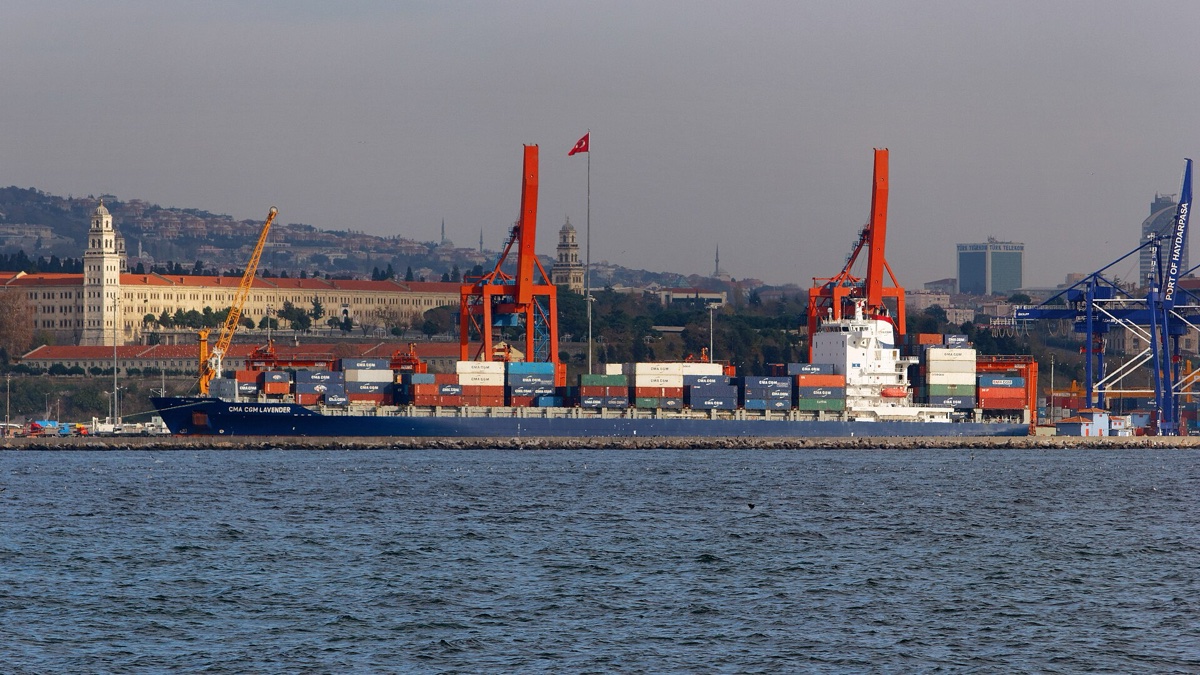
Turkey closed 2025 with $365.37 billion of imports, up 6.2% on the year, against $273.36 billion of exports. The gap, a record $92 billion, made headlines at home, per TurkStat's full-year figures. For an exporter, that deficit reads differently: it is one of the world's biggest shopping lists. Turkey ranks as the 9th-largest importer on the planet, buying everything from Russian crude to Brazilian cotton to Chinese telecom gear. This guide breaks down Turkey import data for 2026: what the country buys, who supplies it, where the official numbers live, and how to turn shipment records into a ranked list of Turkish importers.
The 30-second version
- Turkey imported $365.37 billion of goods in 2025, up 6.2%; the trade deficit hit a record $92 billion.
- Mineral fuels ($62.5B), machinery ($41.6B) and vehicles ($36.9B) lead the mix; unwrought gold (HS 7108) was the single largest product at $23.13B.
- China supplied $49.57B (a 13.6% share), Russia $42.37B, Germany $30.11B.
- EU–Türkiye goods trade set a record €217.6 billion under the 1995 Customs Union; 35.3% of Turkish imports come from the EU.
- Turkey publishes aggregate statistics only. Turkish importer names come from mirrored partner-country shipment records.
What does Turkey import the most?
Mineral fuels lead at $62.47 billion, followed by machinery (HS 84) at $41.64 billion and vehicles (HS 87) at $36.87 billion, out of $365.37 billion total 2025 imports, per TurkStat data via Trading Economics. The single biggest product line is stranger: gold.
Here is the 2025 cut by HS chapter, the same view you get when reading Turkey import data by HS code:
| HS chapter | Category | 2025 imports |
|---|---|---|
| 27 | Mineral fuels and oils | $62.47B |
| 84 | Machinery, boilers, mechanical appliances | $41.64B |
| 87 | Vehicles and parts | $36.87B |
| 85 | Electrical and electronic equipment | $29.97B |
| 71 | Pearls, precious stones and metals (incl. gold) | $28.11B |
| 72 | Iron and steel | $22.21B |
| 39 | Plastics and articles | $15.63B |
| 29 | Organic chemicals | $8.93B |
| 30 | Pharmaceutical products | $6.50B |
Gold deserves its own line. At $23.13 billion, unwrought gold (HS 7108) outranked passenger cars ($22.33B, HS 8703) and refined petroleum ($17.58B, HS 2710) as Turkey's #1 import product of 2025, per HS-level trade analysis. Lira-wary households and the central bank both treat bullion as a savings vehicle. New to chapter codes? Start with how HS codes work. One wrinkle for filers: Turkey's national tariff line, the GTİP, runs 12 digits, and only the first six match the international HS system.
Where does Turkey import data actually come from?
Two official layers, both aggregate. TurkStat (TUİK) publishes the definitive monthly foreign-trade bulletins, with values by HS code and partner country. The Ministry of Trade's preliminary bulletin lands faster and is what Turkish media quote first. November 2025, for example: imports of $30.5 billion, up 2.6% year on year, per Fibre2Fashion's readout.
Neither layer names a single buyer. Turkey, like most of Europe and unlike the United States, does not release bill-of-lading manifests or consignee names. You cannot pull "who imported polypropylene into Gebze last quarter" from any official Turkish source. Practitioners close that gap with mirror data: partner-country export records that show who shipped what into Turkey, joined with licensed shipment databases that carry Turkish consignee names where disclosure rules allow. The workflow is the same one used for finding buyers with customs data anywhere else; only the source layer changes.
Who supplies Turkey? China, Russia and a river of gold
China led 2025 with $49.57 billion, a 13.6% share, mostly telecom equipment and computing hardware. Russia followed at $42.37 billion in crude, refined products and coal; sanctions rerouted Russian energy south and Turkish refineries absorbed it (the Russia trade-data picture shows the other end of that lane). Germany sent $30.11 billion, the US $18.11 billion of LNG, aircraft and cotton, and Switzerland $15.74 billion, of which 82.75% was gold, per 2025 partner-level data.
Strip out energy and bullion and the ledger changes character: what remains is mostly factory inputs, machinery, steel, plastics and chemicals feeding an export machine aimed at Europe.
What Turkey import data reveals about the Europe-Asia gateway
Turkey is the EU's 5th-largest trade partner, and 2025 EU–Türkiye goods trade set a record above €217.6 billion, per the European Council's trade infographic. Some 42.7% of Turkish exports go to the EU and 35.3% of its imports come from it. The 1995 Customs Union clears industrial goods duty-free in both directions, which is why so many Asian inputs enter Turkey, become cars, cables or T-shirts, and exit toward Hamburg.
Textiles show the machine at work. Turkey exported $35.1 billion of textiles in 2024 (latest full year) while importing $12.2 billion, led by $2.52B from China, per OEC data. Upstream, Turkish mills are set to import roughly 825,000 MT of raw cotton (HS 5201) in MY 2025/26, and the supplier table is flipping: Brazil now holds about 33% of that market, overtaking the US at 29%, whose shipments fell 51% year on year in the first half of MY 2024/25, per USDA FAS Ankara. A cotton trader watching mirror data saw that switch coming two quarters early: Brazilian bale shipments into Izmir kept climbing while US offers sat unanswered. The same trail runs one step downstream in cotton yarn trade data.
The India-Turkey lane: cooler, still worth mapping
India–Turkey trade reached $8.71 billion in FY2024-25, with India shipping $5.72 billion and buying $2.99 billion, per IBEF. The corridor has cooled sharply since: April–November of FY2025-26 logged $4.59 billion in total trade. The product mix barely moved, though. India's lead lines into Turkey remain electrical machinery ($344.75M), mechanical machinery ($320.51M), vehicles and parts ($303.74M), organic chemicals ($265.33M) and iron and steel ($250.77M).
A shrinking lane raises the stakes on targeting. When fewer Turkish importers are actively buying steel or auto components from a given origin, blanket outreach wastes months. The exporters still winning orders are the ones using data-backed targeting to identify the specific Istanbul or Bursa buyers whose purchase history matches their product, then building a shortlist before the first email goes out.
How do you find Turkish importers?
Since Turkey publishes no consignee-level records, you work from mirror data and rank from there. The sequence most export teams use:
- Fix the HS code first. Map your product to the 6-digit heading; Turkish buyers filter by GTİP, and a wrong chapter poisons every later step.
- Pull mirror shipment records. Partner-country export data shows shipments into Turkey with product, value, volume and, where available, the Turkish consignee.
- Rank by consistency, not size. Twelve shipments a year signals a working distributor; one giant order is often a project buy that never repeats.
- Screen for the EU angle. A Turkish importer re-exporting into the EU under the Customs Union buys inputs on a schedule and cares about certification (CE marking, REACH for chemicals).
- Verify before quoting. Cross-check the company against its trade history and registry records, then open with their own volumes.
One auto-components exporter skipped the famous Bursa OEM names and pitched three mid-table importers ranked #7 to #12 by shipment count. Two replied inside a week. The big names never did.
How ShipScout helps
ShipScout puts 11B+ shipment records across 240+ countries behind one search box, including the Turkey import data trail visible through partner-country records, so the sequence above takes minutes:
- Search your product or HS code with Turkey as destination and see real flows: values, volumes, origins, dates.
- Rank Turkish importers by shipment count and volume instead of directory listings.
- Profile before pitching. Open any company in the importer directory to see trade history, sourcing countries and product mix.
- Reach out with contact intelligence where available, and lead with numbers from the buyer's own lane.
A $365 billion import bill means somebody in Turkey is already buying what you make. Start a free trial and pull your first ranked list of Turkish buyers today.
See who’s importing goods into Turkey right now.
ShipScout turns 11B+ shipment records across 240+ countries into a live list of verified buyers and suppliers — ranked by volume, with the contacts to reach them. Create a free account and run your first search in minutes.
Start your free trial →